 By
By 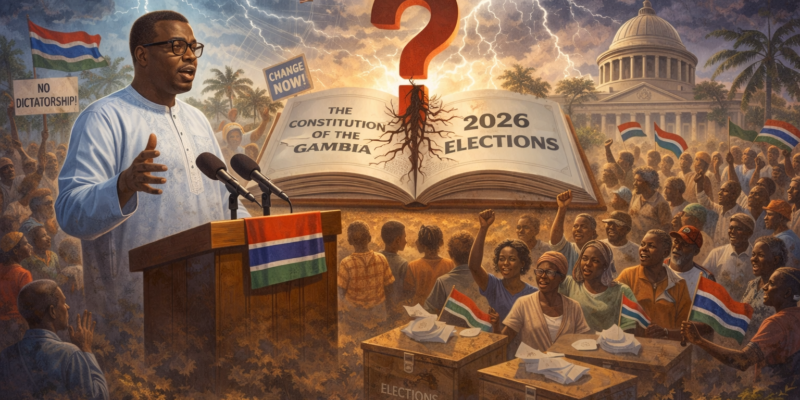
Introduction
Since 2017, key political actors including the ruling National People’s Party (NPP), and the opposition parties particularly the United Democratic Party (UDP) in The Gambia have failed to reach a consensus to adopt a new constitution that will replace the 1997 Constitution. This prolonged deadlock has deepened the country’s governance crisis, reflecting a critical juncture where elite interests increasingly overshadow national consensus-building. The rejection of both the 2020 and 2024 draft constitutions signals not only a setback but a strategic retreat from democratic commitments, further eroding public trust in the reform process.
With the upcoming December 2026 elections, the implications of the current constitutional impasse on the political stability of The Gambia cannot be overemphasized. This article examines the dynamics of the current constitutional crisis, highlighting the broader peace and security risks it poses ahead of the 2026 general elections. The article concludes with pathways to safeguard Gambia’s fragile democratic transition.
Background to the Constitutional Impasse
The constitutional crisis currently unfolding in The Gambia is rooted in the unfulfilled reform promises made by the incumbent political leadership following the outcome of the 2016 presidential election. Upon assuming office, President Adama Barrow committed to initiating comprehensive constitutional and institutional reforms to consolidate democracy and uphold the rule of law. These promises emerged in the aftermath of President Yahya Jammeh’s 22-year authoritarian rule, which was characterized by systemic repression, human rights violations, and institutional decay. Consequently, a national consultation process was launched, culminating in the drafting of a new constitution in 2020 through a participatory and inclusive process. The draft constitution embodied progressive democratic principles including presidential term limits, enhanced judicial independence, and checks on executive power. Nevertheless, it was rejected by the National Assembly in September 2020, largely due to opposition by Barrow’s political allies who objected to the retroactive application of presidential term limits and other democratic safeguards.
In response, the Barrow administration proposed a new draft constitution, commonly referred to as the Constitution of the Republic of The Gambia (Promulgation) Bill, 2024. However, it has been criticized by the opposition parties for lacking the retroactive two term limit and other provisions crucial for anti-corruption, and accountability, deepening political polarization and fueling a constitutional deadlock. After the first attempt in March 2025, the 2024 draft constitution promulgation bill failed to pass it second reading on July 7, 2025, at the National Assembly. Per the law, the bill needed a three-quarter majority (43 out of 58 votes). However, during the vote ,35 lawmakers voted in favour while 21 of them voted against and 1 absent.
Stalled Constitutional Reform and Matters Arising
As indicated earlier, the failure to adopt the 2020 and 2024 draft bills is mainly due to the intense political disputes over presidential term limits and attempts to retain executive powers. On presidential term limits for instance, a major sticking point was the 2020 draft’s provision to make presidential term limits retroactive, which would prevent President Adama Barrow from running again in 2026. The 2024 draft removed this clause, creating further controversy. The revised 2024 constitution is also seen as weaker than the 2020 version because of proposals to remove parliamentary oversight for appointments including that of the judiciary. Critics, including civil society organizations (CSOs), have also noted a lack of broad stakeholder engagement in the revised 2024 version.
Given the disagreements among political actors and the failure to reach consensus over either the 2020 or 2024 drafts constitutions, the country continues to be ruled by provisions of the 1997 Constitution which was reviewed in 2001 by President Jammeh to remove term limit. Thus, the 1997 Constitution, which was enacted during Yahya Jammeh’s regime, allows for an unlimited number of five-year terms. Legally, this creates a fertile ground for the current President to contest for a third term in 2026 general elections and beyond in the absence of a new constitution.
The decision by President Barrow and his NPP to run for a third term is considered by many people as a betrayal that defeats the longstanding struggle of Gambians against self-perpetuation. His party however has cited the lack of a new constitution as the legal basis for his eligibility. Even though the incumbent President Adama Barrow promised a new constitution following his election victory in 2016, the constitutional reform process has stalled due to lack of consensus among key political actors. However, without the constitutional reforms, The Gambia is likely to backslide into an autocratic regime which could lead to democratic stagnation. Apart from consolidation of power, President Barrow’s third term bid could deepen political polarization, and perpetuate uncertainty regarding constitutional term limits. Such a move threatens to further erode public confidence in the democratic processes. In addition, Members of The Gambia’s parliament voted in July 2025 to reinstate a clause in the Electoral Bill that substantially increases the financial and logistical requirements for candidates in the upcoming elections. The reform has drawn significant criticism from citizens, political actors and civil society groups, who argue that it will undermine inclusivity and restricts broad democratic participation in The Gambia.
Implications for Political Stability and National Security
The failure to reach consensus on the 2024 draft constitution reflects deep-seated divisions among political elites which is also affecting public confidence in democratic governance. Should this discord persist, it could create more divisions among political actors especially the older elites and the younger generation clamouring for stronger democratic ethos in The Gambia. Already, the main opposition UDP has experienced a wave of defection. Among the deserters is the party’s national organising secretary who resigned to launch the Unite for Change Movement party ahead to the 2026 election. Many Gambians, especially young people, have lost trust in the capacity of UDP or the NPP to govern The Gambia effectively. Therefore, the emergence of the Unite for Change Movement party is seen by many Gambians as a third force that could change the status quo during the December 2026 elections. The party projects itself as the next-generation option, with a leadership that combines youth appeal, technocratic credibility and local governance experience.
In addition, President Barrow’s potential bid for a third term stemming from the continued failure to adopt a new constitution has emerged as a major flashpoint that could undermine The Gambia’s already fragile democratic stability, social cohesion, and overall peace and security. Given that he campaigned in 2016 as a reformer to end autocratic rule with promise of implementing a three-year transition, seeking a third term is perceived as a betrayal and a reverse to the autocratic rule of his predecessor, Yahya Jammeh. While the opposition parties remain fractured, unable to mount a cohesive challenge to Barrow and the NPP, they nevertheless retain sufficient strength and capabilities to escalate political tensions ahead of the 2026 elections based on previous election experiences.
Already, the early warning signs of potential violence ahead of the 2026 elections is manifesting in various forms. The re-emergence of repressive tactics reminiscent of the Jammeh era is evidenced by the selective enforcement of the Public Order Act (POA), which restricts freedom of assembly and expression. Civil society actors and human rights defenders have been subjected to harassment and intimidation, resulting in a climate of fear. In August 2025, nineteen (19) individuals mostly youth and civil society actors were arrested in Banjul after they demonstrated against a mobile data price increase in the country. In addition, insecurity across The Gambia threatens not only communities’ safety and security but could also impact negatively on the upcoming 2026 December elections. Besides, ethnic and tribal divisions have also intensified since the departure of former President Jammeh. The politicization of ethnicity has become endemic, thereby threatening national cohesion and inclusivity. Social media platforms and Artificial intelligence (AI) have become tools of political manipulation to propagate hate speech, misinformation and disinformation. The ongoing deterioration of civic freedoms, coupled with insecurity and information disorders, creates a volatile environment ahead of the upcoming elections.
Pathways for Safeguarding Gambia’s Fragile Democratic Transition
Gambia’s democracy remains vulnerable. The continuation of the deadlock coupled with increasing political polarization and a general sense of disillusionment among the populace will heighten tension and uncertainty ahead of the upcoming elections. The stalled reforms highlight the need to overcome political divisions to ensure that reforms align with popular expectations, such as presidential term limits, which 87% of citizens supported according Afrobarometer report in 2024. Therefore, addressing the crisis requires building political consensus to pass the new constitution bill or amending the 1997 constitution to introduce presidential term limits, strengthen human rights, and ensure institutional independence.
In this respect, the Supreme Islamic Council, the Christian Council, civil society actors, women and youth groups are encouraged to jointly work closely with the stakeholders as a coalition towards resolving the political impasse through sustained national inclusive dialogue processes and policy advocacy engagements. Regional actors like the Economic Community of West African States (ECOWAS), the African Union, United Nation Office for West Africa and the Sahel (UNOWAS) and development partners could further complement the national efforts by sustaining diplomatic engagements with the stakeholders. This will ensure that the political actors reach a consensus for peaceful elections in December 2026. Sustained diplomatic pressure and engagement could ease tensions and positively influence the trajectory of the current constitutional impasse. ECOWAS in particular could leverage its presence and influence to play a more active mediation role in breaking the deadlock, through consensus building on key provisions of the draft 2020 and 2024 constitutions to help draft a new roadmap for completing the reform process.
AUTHOR
Ansoumane Samassy SOUARE Regional Analyst, Democracy and Governance-WANEP-Regional |
Disclaimer: The views expressed in this publication are those of the authors and not necessarily those of WANEP. While every attempt has been made to ensure that the information published is accurate, no responsibility or liability is accepted for any loss, damage or disruptions caused by errors or omissions whether such errors or omissions result from negligence, or any other cause.



Comments