 By
By 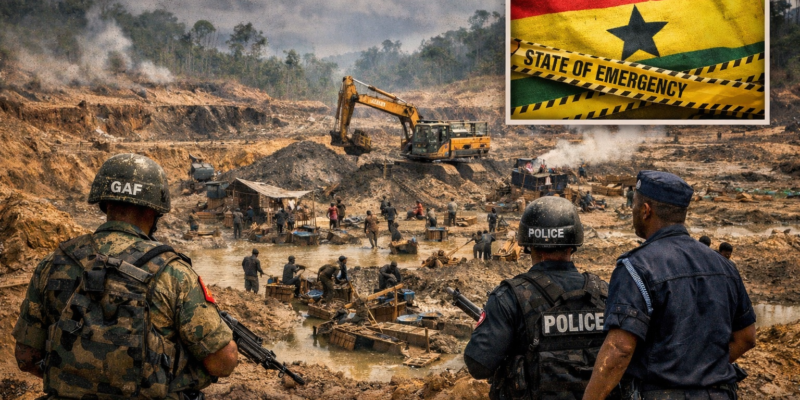
Introduction
Illegal mining, also known as ‘‘Galamsey’’ in Ghana, is a human security issue that threatens the environment, and people’s livelihoods. It involves mining activities without a license, close to water bodies, diversion of tailings into water, and the use of dangerous chemicals like mercury and cyanide. The phenomenon is pervasive across the country, causing deaths, destruction of vegetation, farmlands, and polluting water bodies. Despite the anti-galamsey actions of successive governments including the deployment of joint security taskforce, illegal small-scale mining (galamsey) remains a persistent challenge with no lasting solution in sight.
The pervasiveness of galamsey has fostered a troubling culture of acceptance, leading to growing public demands for the declaration of a state of emergency amid the apparent ineffectiveness of existing enforcement mechanisms. Under Article 31 of the 1992 Constitution of Ghana, the President is empowered to declare a state of emergency where a situation poses a threat to the life of the nation. Some civil society organisations and environmental activists including the Ghana Coalition Against Galamsey (GCAG) argue that the scale of environmental degradation, water insecurity, and public health risks associated with galamsey constitutes such a threat and therefore warrants an extraordinary state response. However, a critical question remains: can the deployment of temporary and exceptional legal and administrative measures under a state of emergency meaningfully address the complex challenges posed by galamsey? This article interrogates this question by critically examining the implications of such a declaration and assessing whether, on its own, a state of emergency constitutes a sufficient response in the fight against galamsey.
Overview of “Galamsey” Activities
Galamsey in Ghana dates back to the colonial era, when it operated largely as a low-technology “pick-and-shovel” or “gather-and-sell” enterprise, relying on rudimentary tools and artisanal methods. Contemporary galamsey mining, however, has become relatively more mechanized, employing excavators, bulldozers, and other heavy-duty equipment and increasingly chemically intensive, causing significant environmental disruption and pollution. It is widespread across the country, but highly concentrated in specific regions and districts. The key hotspots are the Western region (Tarkwa-Nsuaem Municipal, Amenfi East District, and Prestea-Huni Valley District), Ashanti region (Amansie Central/South/West Districts), Eastern region (Kyebi, Kwabeng, and Anyinam) and Central region (Dunkwa-On-Offin and Diaso). Several towns and villages, forest reserves and water bodies including the Ankobra, Offin, Birim, Tano, and Densu have been significantly impacted.
Over the years, galamsey activities have posed significant threats to environmental, food, water, health, personal, community and state security, resulting from destruction of vegetation, farmlands, forest reserves, water sources and loss of lives. Heavy metals like mercury and cyanide are polluting water bodies and contaminating food crops, leading to birth deformities, kidney problems, skin diseases, child morbidity, reproductive health problems, and other strange diseases. Food security is threatened by polluted soils. Water treatment plants are shutting down, leading to water scarcity while cocoa production is negatively affected.
A study by the United Nations Children’s Fund (UNICEF) and the Food and Drug Authority (FDA) of Ghana in 2025 revealed widespread sources of lead exposure in food and consumer items. Aside the public health concerns, there are also national security concerns which include the possibility of violent extremists taking advantage of illegal mining to raise funds for criminal activities. This concern is based on experiences from other West African countries like Mali and Burkina Faso where violent extremists have engaged in gold mining to fund their activities.
Government Responses
Successive governments before the Fourth Republic have implemented several measures to address the galamsey problem. Under the Rawlings’ regime (1981-2001), the Mercury Law, Small-Scale Gold Mining Law, Precious Minerals Marketing Corporation Law, and the Minerals and Mining (Amendment) Act of 1994 were enacted. These laws sought to regulate mining and the use of mercury by small-scale gold miners, streamline small-scale gold mining, and provide official channels for marketing gold produced by these miners. The Minerals Commission Act of 1993 was also established to ensure the management of Ghana’s mineral resources and the coordination of mining policies. Under President Kuffour’s administration (2001-2009), the Minerals and Mining Act, 2006 (Act 703) was strengthened to improve licensing and environmental compliance. Late Professor Mill’s administration (2009- July 2012) pursued public education on the effects of galamsey, inter-agency collaboration among the Minerals Commission, Foresty Commission and Environmental Protection Agency (EPA), and passed two legislative instruments (L.I.) on minerals and mining general regulations (L.I. 2173, 2012), and on support services regulations (L.I. 2174, 2012). During President John Dramani Mahama’s first term from 2012 to 2017, significant steps were taken to address illegal mining in Ghana. In 2013, the government established an Inter-Ministerial Task Force to combat illegal mining activities. Furthermore, the Minerals and Mining (Amendment) Act (Act 900) and an Artisanal and Small-Scale Mining (ASM) Framework was developed in 2015 to regulate this sector and ensure responsible mining practices.
From 2017 to January 7, 2025, President Akufo-Addo’s administration also implemented measures to combat galamsey. These included Operation Vanguard, Operation Galam-Stop, Operation Halt, the establishment of an Inter-Ministerial Committee on Illegal Mining (IMCIM), enactment of the Minerals and Mining (Amendment) Act (Act 995), and the passage of legislative instruments on licensing regulations (L.I. 2176, 2017), and mineral operations – tracking earth moving and mining equipment regulations (L.I. 2404, 2020). The government also set up an ad-hoc ministerial committee to engage stakeholders and GalamStop platform to assess the fight against galamsey and provide real-time oversight. In addition, community mining schemes (CMS) were implemented to regulate galamsey through the use of community-based structures. Moreover, the government implemented the National Alternative Employment and Livelihood Programme (NAELP) to support the youth with alternative livelihoods in agriculture, re-afforestation, agro-processing and mine support services.
The current President Mahama Administration has also revoked small-scale mining licenses and implemented excavator tracking systems and licensing reforms to monitor their import and use. The government has also held stakeholder engagements with civil society and announced a five-pillar strategy to combat galamsey and promote responsible mining, including stakeholder engagement, regulatory reforms, law enforcement, reclamation, and alternative livelihoods. The National Anti-Illegal Mining Operations Secretariat (NAIMOS) has also been established under the Ministry of Lands and Natural Resources to monitor and coordinate anti-illegal mining law enforcement operations. These efforts by successive governments illustrate that illegal mining is recognized as a national crisis that necessitates serious policymaking. The establishment of legislative and institutional frameworks allow for regulated and coordinated actions of anti-galamsey task forces, aimed at dismantling illegal mining networks and restoring beseeched forests and lands.
The different government initiatives have resulted in increased public awareness, active community engagement, and a national consensus to eradicate galamsey, signaling a commitment at high levels of political authority to combat illegal mining activities. Despite these strengths, there remain significant gaps that hinder the effectiveness of governments’ responses. These include a lack of strong political will, limited resources available to anti-galamsey agencies like NAIMOS, the failure to tackle the root causes of the problem, instances of corruption and collusion, poor planning of programmes and collaborations, an inability to target the financiers or principals in the galamsey industry, and failure to confront community resistance. These limitations have significantly undermined the overall impact of the government’s strategies to combat this pressing issue. In this context, a declaration of a state of emergency is widely viewed by environmental activists and civil society organisations as a necessary and last resort measure to combat the galamsey menace.
State of Emergency: What Does it Mean?
A state of emergency is a legal tool used by both democratic and authoritarian governments to respond to crises such as civil disturbances, natural disasters, security threats, pandemics, and public unrest that endanger national stability, security, and lives. During these times, some functions of government branches, including the executive, legislature, and judiciary, are temporarily suspended, government agencies enforce emergency measures, and citizens are informed of changes they need to make to their daily routines. The authority and procedures for declaring a state of emergency vary by jurisdiction, but the main goal is usually to restore public order. These emergency powers often allow the suspension of civil liberties during national crises. Strategies tend to become militarized and securitized, with the enactment of emergency laws and deployment of security forces to restore order.
Several African countries, including Egypt and Nigeria, have declared states of emergency in response to national crises threatening state survival and human security. Ghana has similarly invoked emergency powers, notably during the 1994 Konkomba–Dagomba–Nanumba–Gonja conflict and following the 2002 murder of the Ya-Na in the Northern Region. The government also relied on emergency powers during the COVID-19 pandemic to impose partial lockdowns, issue stay-at-home orders, and deploy security forces to enforce public health measures.
A state of emergency has both positive impacts and challenges. On the positive side, a state of emergency allows the state to act with urgency and to better deal with crises than it would have been done in normal times, where there are limitations imposed by law. It provides the legal tools for addressing life threatening state problems, protecting constitutional orders, and securing citizen safety, and public order. On the other hand, a state of emergency can be used to justify repressive policies, undermine people’s human rights and freedoms, facilitate the consolidation of authoritarian regimes, cause permanent change of democratic institutions and shift of power, and undermine the oversight powers of the judiciary and legislature. Political actors can use a state of emergency to target or repress political enemies or access emergency funds for their parochial interests.
Constitutional Basis for a State of Emergency
The constitutions of many countries contain provisions for the exercise of emergency powers including who can make the declaration, grounds for declaration and additional powers government exercise during a state of emergency. This means that the “who”, “when”, “where”, and “how” of a state of emergency is often provided for by emergency provisions of a country’s constitution. In Ghana, the exercise of emergency powers by the President is provided for under Chapter Five, Article 31 of the 1992 Constitution and the Emergency Powers Act, 1994 (Act 472). Four legal dimensions underpin a declaration of a state of emergency in Ghana including the grounds for declaration, the procedure or process of declaration, the oversight responsibility of other bodies, and judicial review. The grounds for declaration include natural disasters, war or defense of the country, maintaining public order/life, or securing essentials of life [Article 31(9)]. The procedure involves the President declaring the state of emergency in accordance with the Council of State’s advice, which is published in the Gazette [Article 31(1)] and lasts for seven days unless approved by Parliament [Article 31(4)]. The declaration must be laid before Parliament to decide whether the proclamation should remain in force or should be revoked within 72 hours [Article 31(2), (3)] after notification, and when approved, it lasts for three months [Article 31(5)]. This resolution can be revoked [Article 31(7)] or extended by Parliament for one month at a time [Article 31(6)]. Oversight of the declaration requires consultation with the Council of State and approval by two-thirds majority of all members of Parliament within seven days. The Supreme Court of Ghana has the power to determine the validity of the declaration and create a tribunal to investigate the case of restricted or detained persons during a state of emergency.
Implications of State of Emergency in the Fight against Galamsey in Ghana
Declaring a state of emergency on galamsey in Ghana has both positive and negative implications on livelihoods, protection of the environment and public health, exercise of fundamental rights and freedoms of citizens, and political and security governance.
Anticipated Strategic Gains
A state of emergency can enable a rapid and coordinated response to galamsey by accelerating interventions, dismantling criminal networks and their local collaborators, and safeguarding biodiversity, forest reserves, and water bodies. The President can draw on Act 472 and the 1992 constitution to ensure stricter enforcement of mining laws, deployment of military personnel to affected areas, accelerate equipment seizures, access emergency funds and justify exceptional resource allocation to restore the degraded environment, clean water bodies, and address the public health impact of the menace. Under a state of emergency, institutional reforms can also be fast-tracked without much bureaucratic hurdles to ensure effective regulation of mining activities and protection of the environment.
Furthermore, declaring a state of emergency would signal strong political will and commitment to ending galamsey, potentially galvanising citizen support, cooperation, and collaboration. By reinforcing public confidence that the state is prioritising lives, health, and security, such a move could encourage citizens to share intelligence and assist in exposing principal–agent failures, criminal networks, and entrenched “deep-state” actors within the galamsey industry.
Risks and Trade-offs
First, a state of emergency grants the Executive expanded powers to implement extraordinary measures to combat galamsey, including the militarisation of mining zones. Such measures may be pursued with limited judicial oversight, increasing the risk of security force excesses and weakened accountability. In this context, the expansion of executive authority can undermine the oversight roles of the Judiciary and Parliament, enabling the circumvention of transparency, scrutiny, and accountability. Consequently, a state of emergency may be abused as a tool to legitimise the suppression of dissent, bypass democratic processes, target political opponents or perceived enemies, and facilitate discriminatory policing, particularly in opposition strongholds.
Second, declaring a state of emergency in galamsey-affected areas would result in the suspension of fundamental rights and freedoms guaranteed under Chapter Five (Articles 12–30) of the 1992 Constitution, including freedoms of movement, assembly, expression, and protections relating to liberty, equality, and fair hearing. Such areas would be subjected to heightened surveillance, curfews, and movement restrictions, severely constraining everyday life choices. Under Article 31(10), actions taken by the President or agents acting on presidential directives during a state of emergency, provided they are deemed “reasonably justifiable” are shielded from constitutional challenge, effectively limiting avenues for accountability even where rights violations occur.
Third, the persistence of galamsey is closely linked to livelihood dependence, as many participants cite the absence of viable alternative sources of income. Declaring a state of emergency would likely trigger heavy crackdowns that displace livelihoods and alienate local populations dependent on informal mining, potentially provoking organised and armed resistance, as seen in aspects of the ongoing NAIMOS operations, with broader risks of destabilisation. Beyond galamsey actors, movement restrictions and curfews would also severely disrupt legitimate economic activities. People can also lose their properties, businesses and source of livelihoods during a state of emergency because the President acting under Act 472 can cause any property to be taken possession of or controlled on behalf of the State. Moreover, the President can cause the compulsory acquisition of any property, exposing individuals and businesses to the loss of assets and livelihoods.
Is Declaring a State of Emergency Enough?
Weighed against its anticipated strategic gains and associated risks and trade-offs, the central question remains whether a declaration of a state of emergency, on its own, is sufficient to effectively address the galamsey menace. As discussed earlier, a state of emergency can ensure urgency and acceleration of anti-galamsey response measures, but it could also lead to disruptive impact on enjoyment of fundamental human rights and freedoms, livelihoods and local economies. While implementing a state of emergency may help to combat galamsey, the results may be short-term if emergency measures are not accompanied by comprehensive reforms that strengthen mining regulations and institutions, address alternative livelihoods gaps, promote community and stakeholder engagement and change the mindset that see galamsey as a normal and acceptable practice. Moreover, it may succeed in confronting the criminal networks and their local collaborators, but the disruptive impact of curfews and restriction of movements on the populations could increase their economic vulnerabilities and potentially lead to the creation of a new crisis. The necessity of a state of emergency on galamsey therefore lies in finding a balance between these issues.
Overall, while securitised responses are necessary particularly against armed criminal networks involved in galamsey, they are not, on their own, a sustainable solution. The government must pursue a long-term, inclusive strategy involving political parties, communities, and civil society to reform the mining sector, strengthen regulation, and promote a culture of responsible mining. In this context, a state of emergency should be viewed not as a solution in itself, but as a limited window for rapid reforms and addressing the underlying drivers of the menace. Given the adaptive nature of galamsey networks in response to operations such as NAIMOS, effective prevention requires a deeper understanding of the interactions among criminal financiers, local collaborators, and principal–agent networks. Crucially, the state must also invest in sustainable alternative livelihoods and employment opportunities, particularly for communities dependent on illegal mining, to prevent relapse and the emergence of new, complex crises.
AUTHORS

Dr. Festus Kofi Aubyn Regional Coordinator Research and Capacity Building WANEP-Regional
|

Chrispin Mwinkyogtaa Kuupiel Ph.D. Candidate, Department of Peace Studies, School of Development Studies University of Cape Coast, Ghana |
Disclaimer: The views expressed in this publication are those of the authors and not necessarily those of WANEP. While every attempt has been made to ensure that the information published is accurate, no responsibility or liability is accepted for any loss, damage or disruptions caused by errors or omissions whether such errors or omissions result from negligence, or any other cause.




Comments